

On November 10–11, 2026, the first All-Russian Forum with International Participation, “Melnikov Readings,” was held in Moscow at the Clergy House at Rogozhskoye. Over the two days, it brought together more than two hundred participants and listeners. The event was organized by the Russian Orthodox Old Believer Church. The Readings are dedicated to the 150th anniversary of the birth of Fyodor Yefimovich Melnikov (1876 is considered one of the most likely years of his birth), as well as the 180th anniversary of Metropolitan Ambrose’s joining the Church. They were held on the eve of the commemoration of the Holy Hierarch (November 12, New Style).

The Consecrated Council of the Russian Orthodox Old Believer Church in 2025 blessed events marking the 180th anniversary of the restoration of the three-rank hierarchy in the Old Belief, entrusting their organization to Priest Aleksandr Pankratov and Dmitriy Ivliyev. Almost immediately, Aleksandr Anatolyevich Prigarin, Doctor of Historical Sciences and professor at the Russian State University for the Humanities, joined the working group.

During the two-day forum, 25 people gave presentations at the Melnikov Readings. They included seven doctors and seven candidates of sciences, as well as four university instructors and four clergy members. Participants who responded to the organizers’ invitation came from Bucharest, Romania; Chisinau, Moldova; St. Petersburg; Veliky Novgorod; Petrozavodsk; Bryansk; Kaluga; Borovsk; Novosibirsk; and Barnaul. The presentations from the Melnikov Readings are to be published in both electronic and print formats. Anyone interested will also be able to watch recordings of the presentations on the Melnikov Readings website.

Metropolitan Korniliy thanked the organizers for the high standard of this large-scale event, and benefactor Lyubov Leonidovna Belomestnykh for supporting this important public and Church initiative.
Opening Ceremony
The Melnikov Readings opened in a festive atmosphere in the Assembly Hall of the Clergy House. Metropolitan Korniliy of Moscow and All Russia, Archbishop Yevmeniy (Mikheyev) of Chisinau and All Moldova, and Archbishop Yevfimiy (Dubinov) of Kazan-Vyatka, St. Petersburg, and Tver addressed the forum with welcoming remarks. The hierarchs emphasized the importance and timeliness of the forum. Greetings from secular organizations followed.


Konstantin Leonidovich Blazhenov, Deputy Director of the Department of National Policy and Interfaith Relations of Moscow and Head of the Office for Relations with Religious Organizations, noted in his remarks the ongoing interaction and constructive cooperation between the Government of Moscow and the Moscow Old Believer Metropolitanate.
Greetings from Vyacheslav Vasilyevich Fomichyov, a deputy of the State Duma of the Russian Federation, were read by Priest Sergiy Bobkov, rector of the Church of the Prophet Zechariah in Noginsk (Bogorodsk), Moscow Region. The message highlighted F. E. Melnikov’s collaboration with Arseniy Ivanovich Morozov, whose memory V. V. Fomichyov has worked to preserve for many years.

N. A. Kalinichev, head of the administration of the Borovsk Municipal District in Kaluga Region, extended warm greetings to the forum. Nikolay Aleksandrovich noted that Borovsk is historically associated with two pillars of the struggle for the Old Faith at the very beginning of the seventeenth-century Schism: Archpriest Avvakum and Nun Theodora (Boyarynya Morozova). N. A. Kalinichev’s greetings were read by Dmitriy Ivliyev, editor-in-chief of the Metropolitanate Herald.
Anna Geroldovna Bezdudnaya, Director General of the Financial Business Association of Eurasian Cooperation, also offered greetings. The organization’s representative office in Romania is headed by Feodor Afanasov, a well-known public figure in the Russian World and protodeacon of the sister Russian Old Believer Church of Romania. The official greetings then concluded, and the forum began its work.
Plenary Session
The first plenary session of the Melnikov Readings, “Melnikov’s Life and Fate: From Biography to Historiography,” was chaired by Professor Aleksandr Prigarin.
The first to speak was architect and ustavshchik of our Church’s Ligovskaya community in St. Petersburg, the well-known Old Believer figure A. A. Sinelnikov. At the forum, he introduced himself to new acquaintances with the words, “Seven children, twelve grandchildren, and seven great-grandchildren.” His presentation, “Fyodor Melnikov in the Memories of Those Who Knew Him,” was a moving, richly detailed account drawn from his father’s and uncle’s memories of meeting Fyodor Yefimovich. Melnikov died in 1960 at the Manuilovsky Old Believer Monastery in Romania. People who knew Fyodor Yefimovich personally are still alive there. In Russia, there are probably none left, and this personal contact with F. E. Melnikov is truly invaluable. As he shared these memories, the speaker himself wiped tears from his eyes from time to time.


Archpriest Alexander Pankratov, rector of the Russian Orthodox Old Believer Church in Veliky Novgorod and organizer of the Melnikov Readings, delivered a paper entitled “The Belaya Krinitsa Council of 1996: F. E. Melnikov’s Ideas on Old Believer Unity and Historical Reality—Reflections of an Eyewitness Thirty Years Later.” Father Alexander deeply grasped one of the central ideas behind the event: by shaping its themes and lines of inquiry around the name of F. Melnikov, to set in motion long-term efforts to systematize and comprehensively study the history of the Belaya Krinitsa hierarchy.

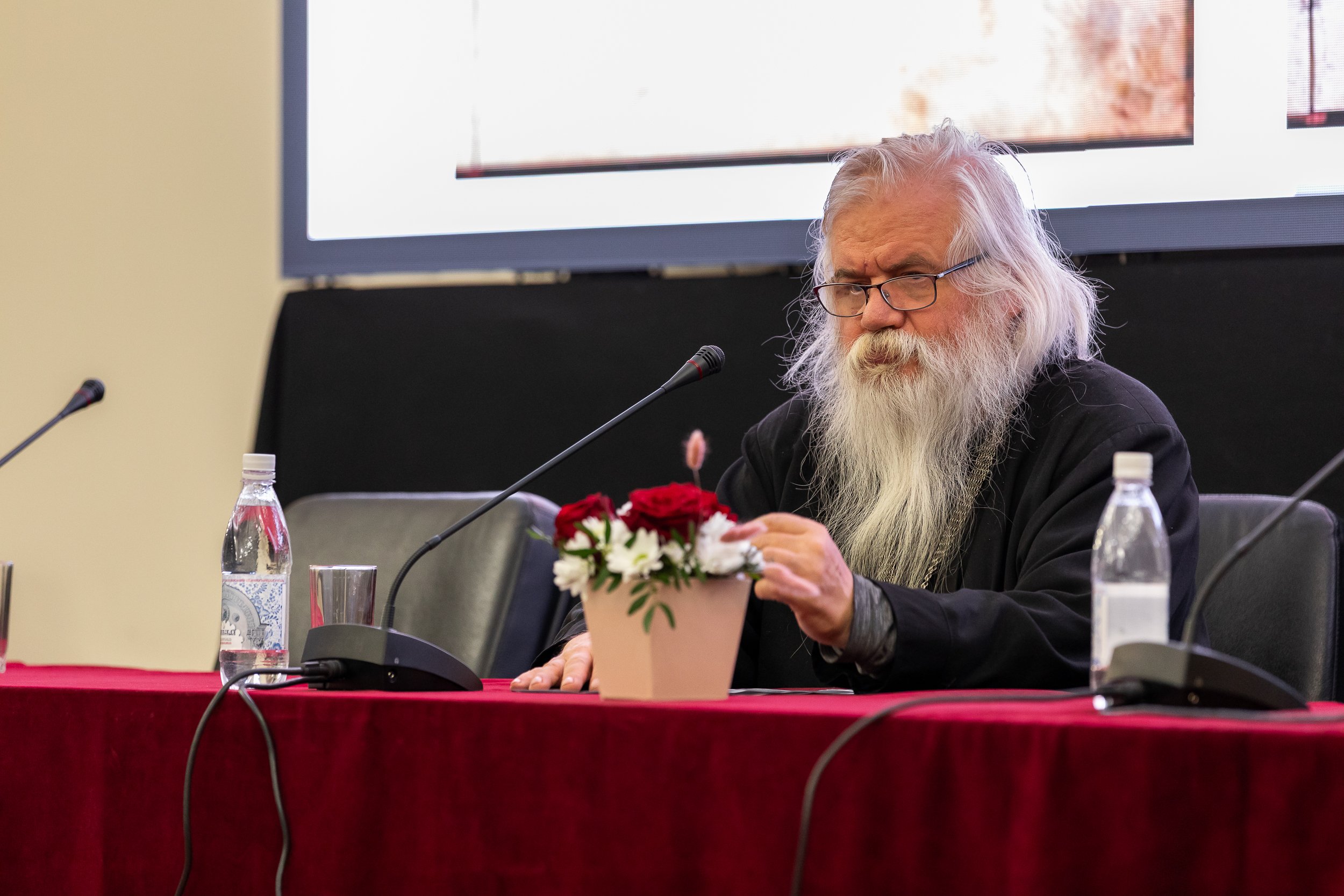
Father Alexander Pankratov’s account and recollections of the historic 1996 Council of the two Old Believer Metropolitanates of the Belaya Krinitsa hierarchy—the Moscow and Belaya Krinitsa Metropolitanates—were accompanied by a presentation of more than thirty archival photographs. It was the first Council of the two equal, brotherly Metropolitanates, each represented by its Primate: Metropolitan Alimpiy (Gusev) and Metropolitan Leontiy (Izot). Exactly 150 years passed between 1846, the year the sacred hierarchy was reestablished, and 1996, when the first joint Council was held. And the Council took place in Belaya Krinitsa itself. At this Council, Metropolitan Ambrose of Belaya Krinitsa was numbered among the saints. Many issues that had accumulated over the decades were resolved, after communication between the two Metropolitanates had been hindered by obstacles imposed by the atheist authorities.
Recognizing the historic significance of this Council, which, regrettably, remains the only joint one to date, Alexander Pankratov, then an ustavshchik and assistant to Metropolitan Alimpiy, kept a diary during the Council. It has since been published several times and can now be found online. Accompanied by photographs, Father Alexander’s recollections allowed forum participants to experience the atmosphere of the historic 1996 Council.
It was after this Council that Archpriest Leonid Gusev managed to obtain a photocopy of Fyodor Melnikov’s typescript, “A Brief History of the Ancient Orthodox (Old Believer) Church.” At the Melnikov Readings, historian Nikola Starukhin of Novosibirsk spoke about how this “nearly illegible” copy of a copy was turned into a complete book layout through two years of work. His paper was entitled “The Discovery, Preparation for Publication, and Publication in Russia of F. E. Melnikov’s Manuscript, ‘A Brief History of the Ancient Orthodox (Old Believer) Church.’”
Candidate of Historical Sciences Nikola Alekseyevich Starukhin devoted much effort and time to bringing Melnikov’s first work, “A Brief History…,” to publication. The publishing baton was then taken up by Old Believer Viktor Baumtrog of Barnaul, Candidate of Physical and Mathematical Sciences, who, together with Alexander Konstantinovich Kholmogorov and other like-minded colleagues, published all of Fyodor Melnikov’s major literary works. Viktor Etmontovich Baumtrog titled his paper “The Publication of F. E. Melnikov’s Collected Works in Barnaul, 1999–2009.”
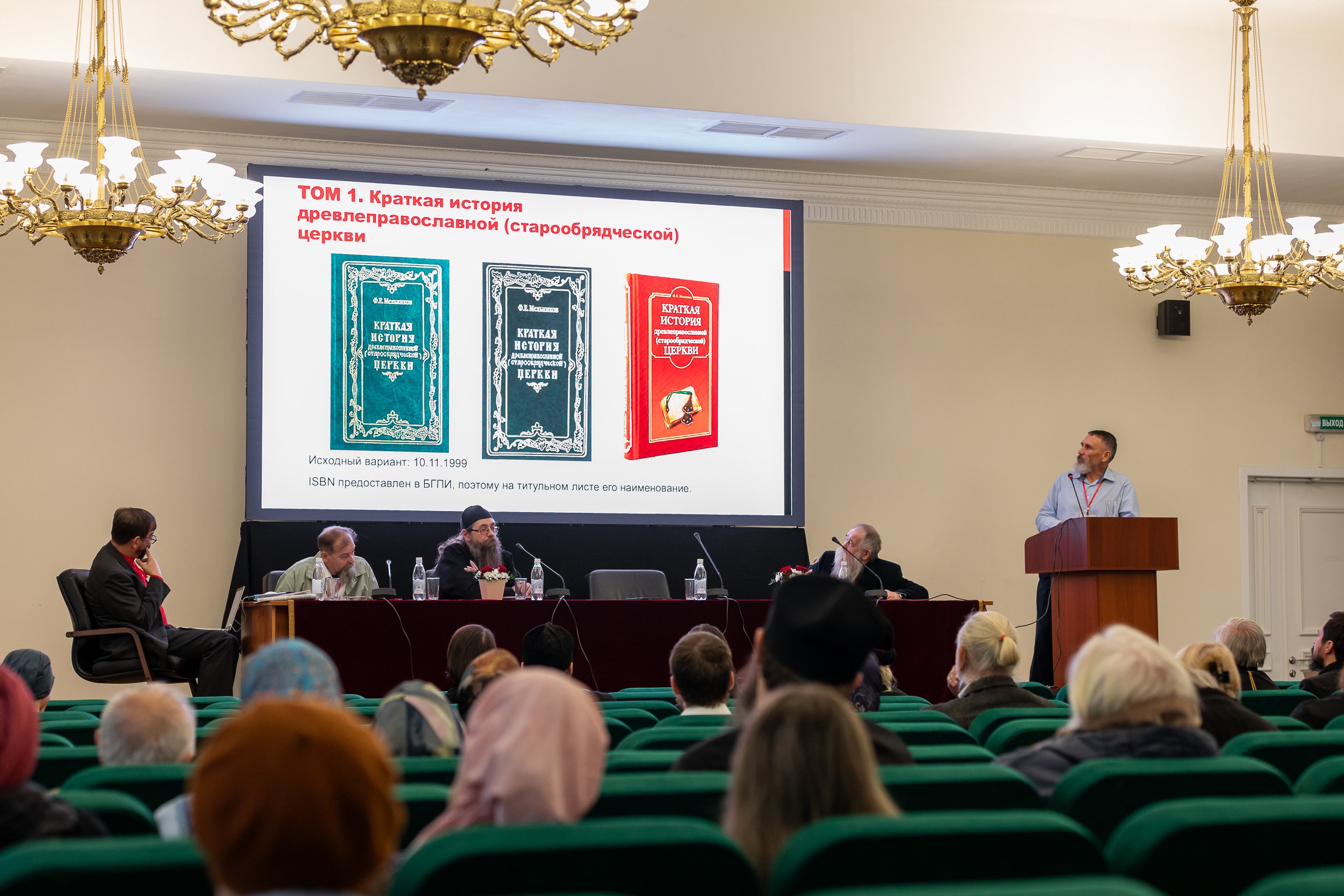
A new edition of F. E. Melnikov’s “A Brief History of the Ancient Orthodox (Old Believer) Church,” prepared with the participation of Nikola Starukhin and Viktor Baumtorg, was presented at Rogozhskoye on the eve of the Feast of the Myrrh-Bearing Women this year. At the Melnikov Readings, those involved in the publishing process finally met and shook hands.

Elena Mikhailovna Yukhimenko, Doctor of Philology and chief research fellow in the Department of Manuscripts and Early Printed Books at the State Historical Museum, spoke in her paper “The Discovery of the Belaya Krinitsa Archive” about the archive of the Belaya Krinitsa Monastery and other documents that came into the possession of N. I. Subbotin, a professor at the Moscow Theological Academy.
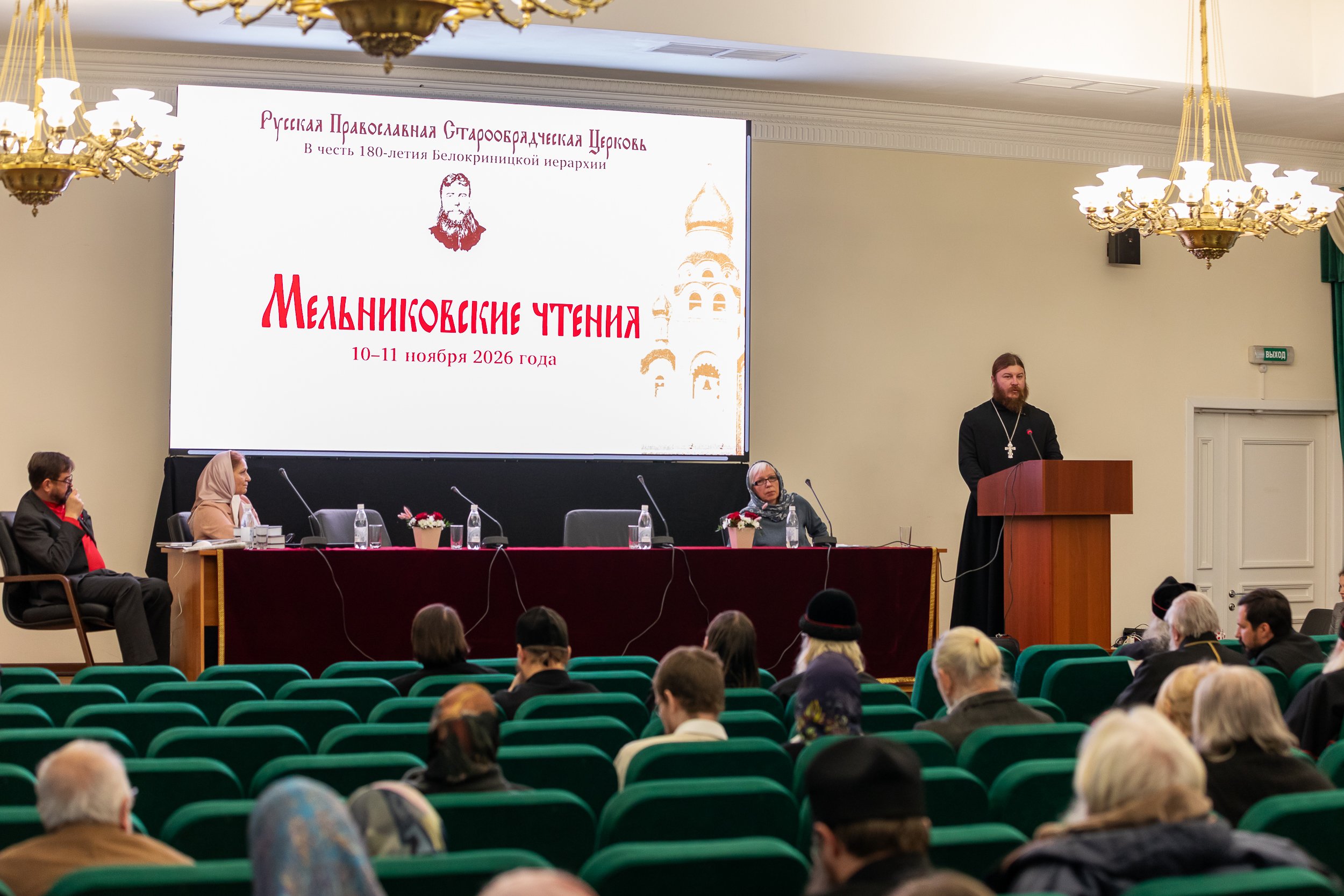
The next speaker was Archpriest Andrey Voznyuk, rector of the Cathedral of the Intercession in Chisinau and dean of the Chisinau Old Believer Diocese. Father Andrey’s passionate address, “The Asceticism of the Word among the Old Believers: The Life and Work of F. E. Melnikov,” made a strong impression on the audience. It was as if everyone could see Fyodor Yefimovich Melnikov at the podium, defending the truth of the true Christian faith with the same fervor in religious debates. Melnikov was not only an apologist, nachetchik, and church historian; he effectively became the chronicler of our Belaya Krinitsa hierarchy. This idea was echoed in the papers of many speakers. Feodor Yefimovich completed his chronicle in 1960, when he reposed in the Lord.
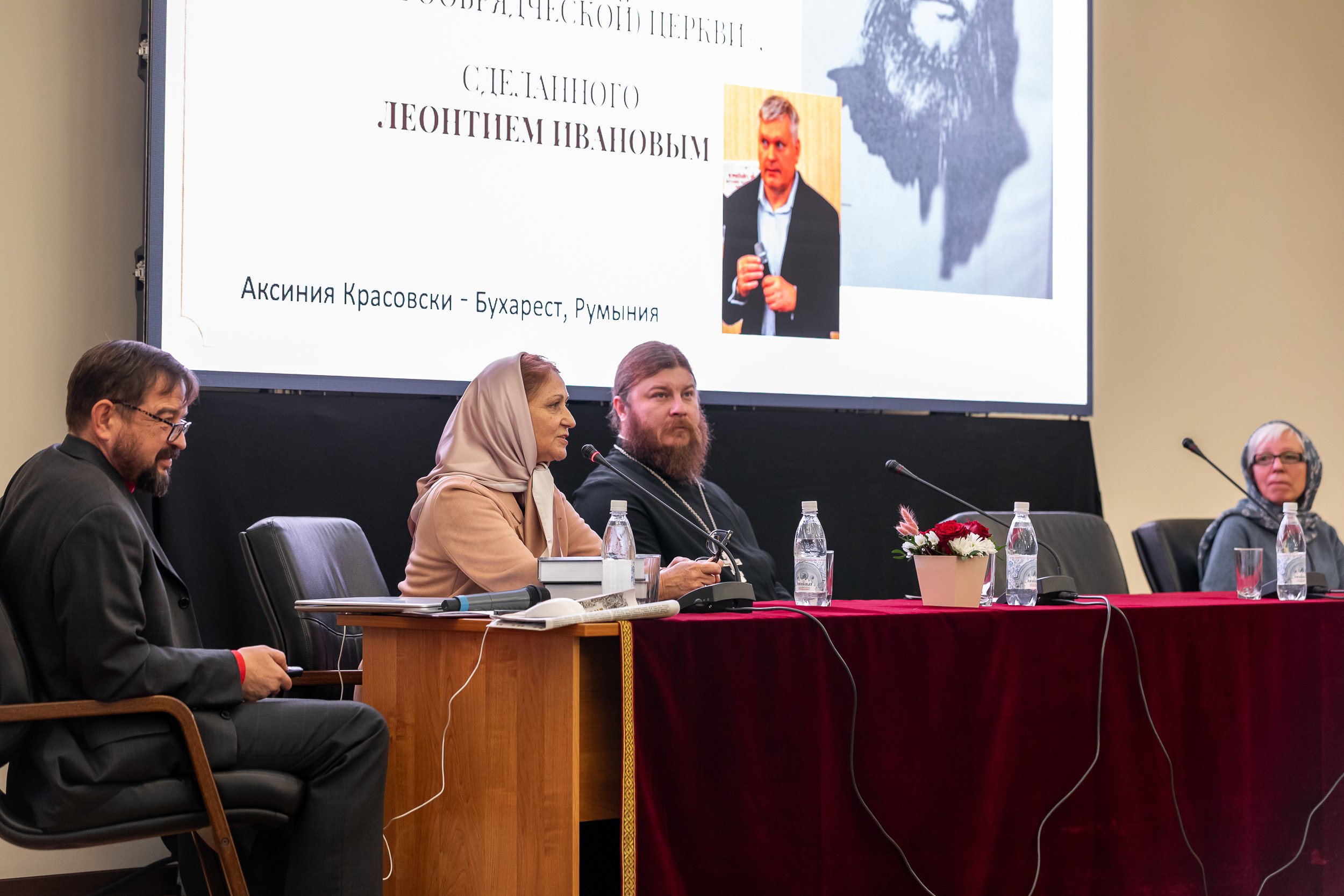
Aksiniya Krasovski of Bucharest deserves special mention. A Doctor of Philology and professor at the University of Bucharest, head of the Department of Russian and Slavic Philology, and a member of the kliros at the Old Believer Church of the Ascension of the Lord in Bucharest, she managed to take part in the readings despite the logistical challenges of traveling between Europe and Russia today. Her paper was entitled “Aspects and Features of the Romanian Translation by Leontiy Ivanov of F. E. Melnikov’s ‘A Brief History of the Ancient Orthodox (Old Believer) Church.’” Aksiniya explained that the Russian editions of Melnikov’s “A Brief History…” published in Russia and Romania differ by at least two chapters. The reasons for these differences are a subject for scholars of Melnikov’s works to investigate.


The plenary session could not be concluded within the time originally allotted, but the presentations and recollections of its participants were so interesting that the schedule had to be adjusted.
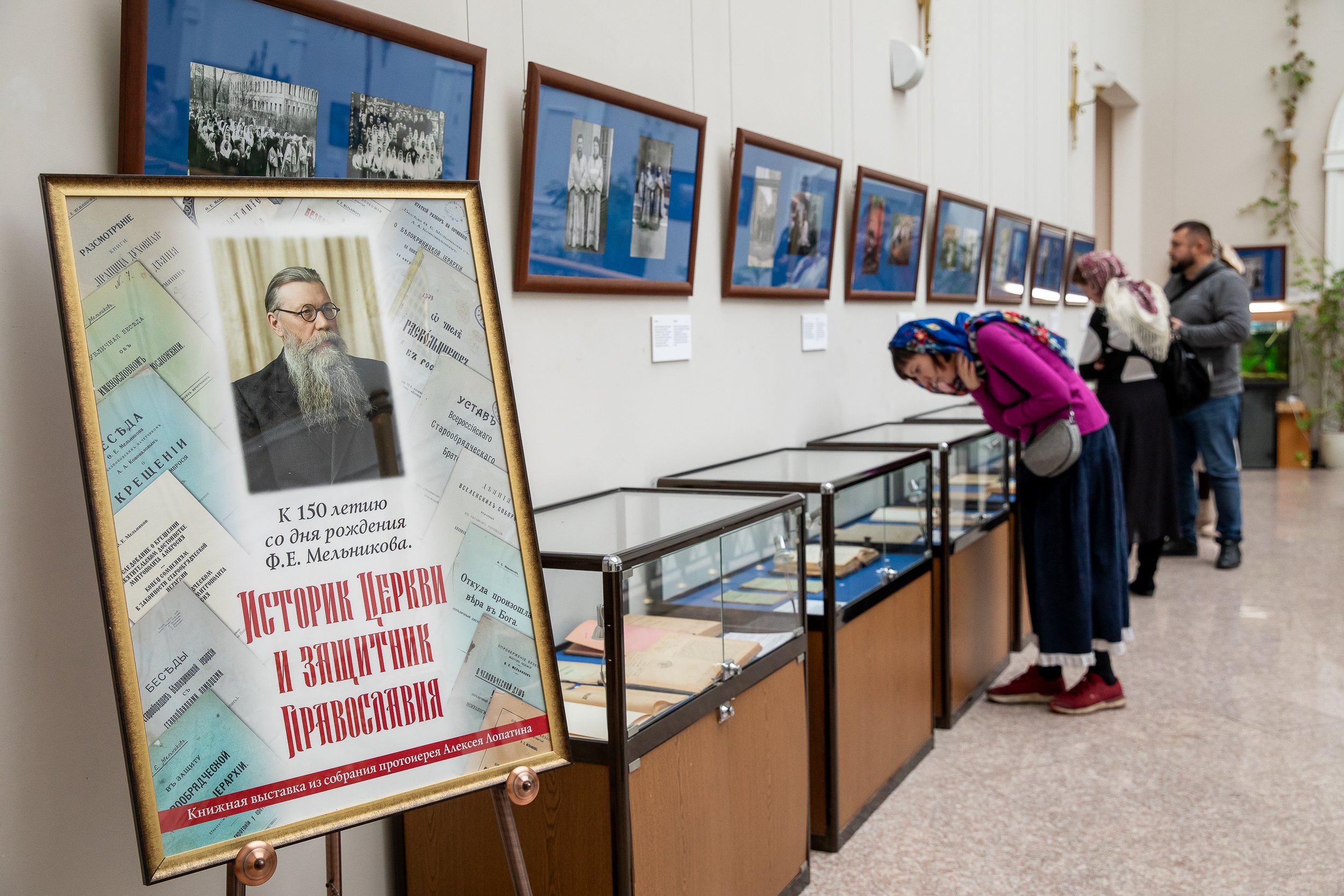
During the break, guests viewed the new book exhibition, “Church Historian and Defender of Orthodoxy: The 150th Anniversary of the Birth of F.E. Melnikov.” On display were pre-revolutionary editions and books published during F.E. Melnikov’s lifetime. Archpriest Aleksey Lopatin and Elena Mikhailovna Yukhimenko prepared the exhibition in the foyer of the clergy house especially for the forum.

Natalya Vasilyevna Abakumova-Zabunova traveled from Chisinau to the Melnikov Readings. A Candidate of Historical Sciences and longtime researcher of the Old Belief in Moldova, she is preparing a book entitled “Old Believer Communities of Moldova” for publication. As a kind of preview of the book, Natalya Vasilyevna gave an engaging presentation entitled “F.E. Melnikov and the Old Believers of Bessarabia (Moldova).”
The forum’s plenary session concluded with a presentation by its moderator, Aleksandr Prigarin, entitled “The Life and Fate of F.E. Melnikov: From Biography to Historiography.” Professor Prigarin recalled his recent scholarly discovery: in the National Archives of the Republic of Moldova, he found an autobiography written by F.E. Melnikov in 1931, shortly after he illegally crossed the border between the USSR and Romania. This unique document does not resolve some disputed questions; on the contrary, it reveals even more gaps in Melnikov’s biography, which has yet to be thoroughly studied or properly documented. Aleksandr Anatolyevich also showed forum participants unique photographs of Fyodor Melnikov at various stages of his life, collected over many years.
Plenary Session: Project Presentations
Immediately after the plenary meeting, the forum’s plenary session, “The Legacy of F.E. Melnikov in Contemporary Cultural and Educational Projects: Presentations and Representations,” opened, moderated by Dmitriy Ivliyev. As the organizers envisioned it, this part of the forum would present recent publishing and cultural projects in the field of the Old Belief more broadly, including projects connected with the Belaya Krinitsa hierarchy.
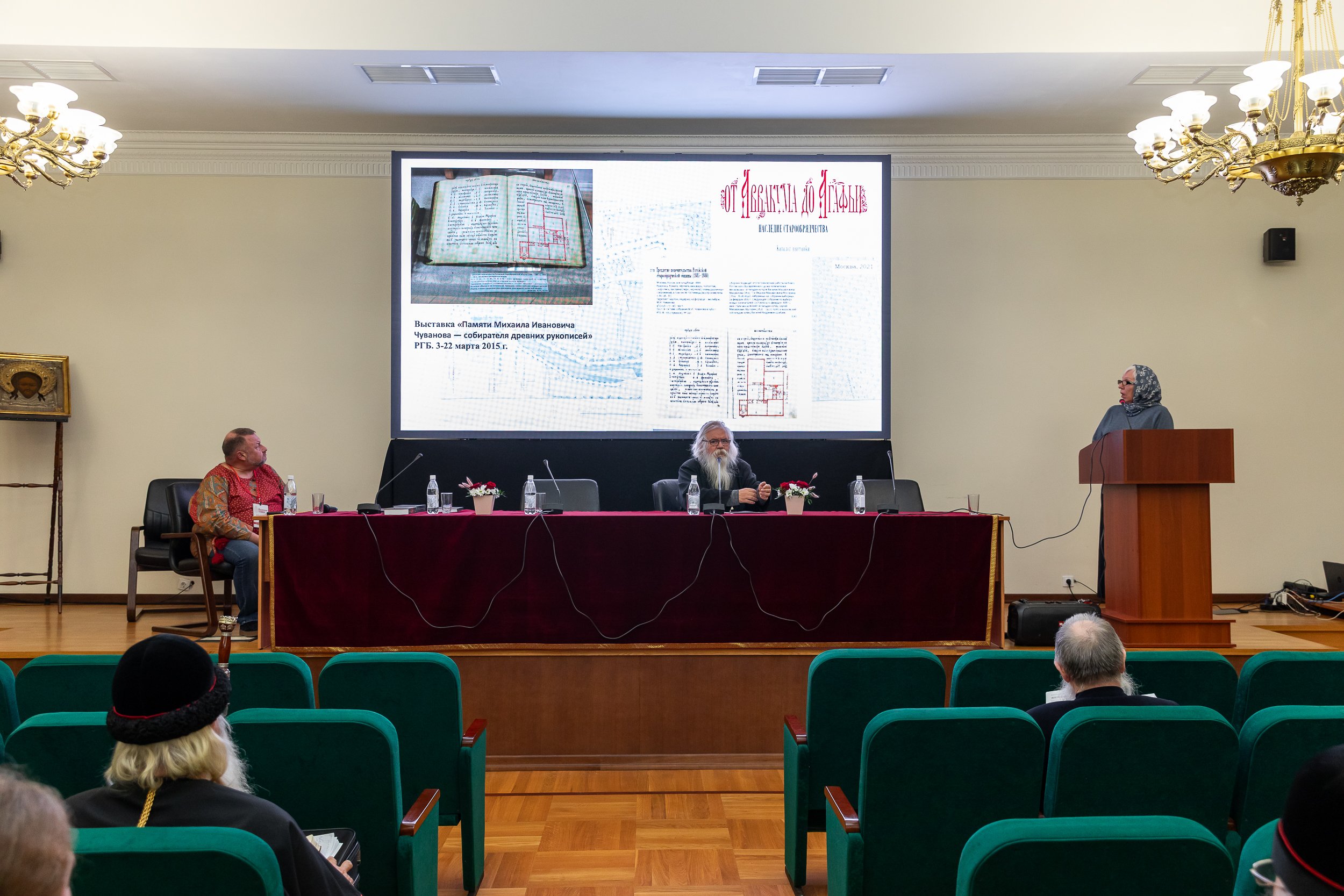
The first book presented at the forum was “The Trustee’s Diary: Rogozhskoye Old Believers, 1885–1888,” by V.M. Mikhailov, published through the efforts of Archpriest Aleksey Lopatin and Elena Mikhailovna Yukhimenko. The book publishes for the first time an important, previously unknown source on the history of the Rogozhskoye Old Believer community: diary entries from 1885 to 1887 by Vasily Mikhailovich Mikhailov, a first-guild Moscow merchant and trustee of the Rogozhskoye almshouse. Elena Mikhailovna Yukhimenko took the initiative to prepare the diary manuscript, preserved in the M.I. Chuvanov collection at the Russian State Library, for publication.
While working on “The Trustee’s Diary,” Elena Yukhimenko and Fr. Aleksey Lopatin also prepared for publication the illustrated volume “Metropolitan Ambrose of Belaya Krinitsa: 180 Years Since His Joining the Orthodox Old Believer Church”, which they also discussed at the Melnikov Readings. Containing unique archival materials and rare illustrations, the volume spans nearly two centuries of Old Believer history: from the 1832 Rogozhskoye Council, which resolved to seek a true bishop, to contemporary contacts between the two branches of the Belaya Krinitsa hierarchy—the Moscow and Belaya Krinitsa Metropolitanates. The book was published with the support of patron and benefactor Lyubov Leonidovna Belomestnykh.

Anna Viktorovna Osipova and Aleksey Valeryevich Ustinov, the authors and editors of the book “Boyarynya Morozova: A Feat of Faith”, published in October this year, then presented their publishing project to a broad audience for the first time. A series of presentations of the book lies ahead, at book fairs and in Borovsk, St. Petersburg, Kostroma, and other cities. The book was published through the patronage of Andrey Stanislavovich Klyamko, Deputy Chairman of the Russian Council of the Ancient Orthodox Pomor Church and a member of the Presidential Council for Interaction with Religious Associations.
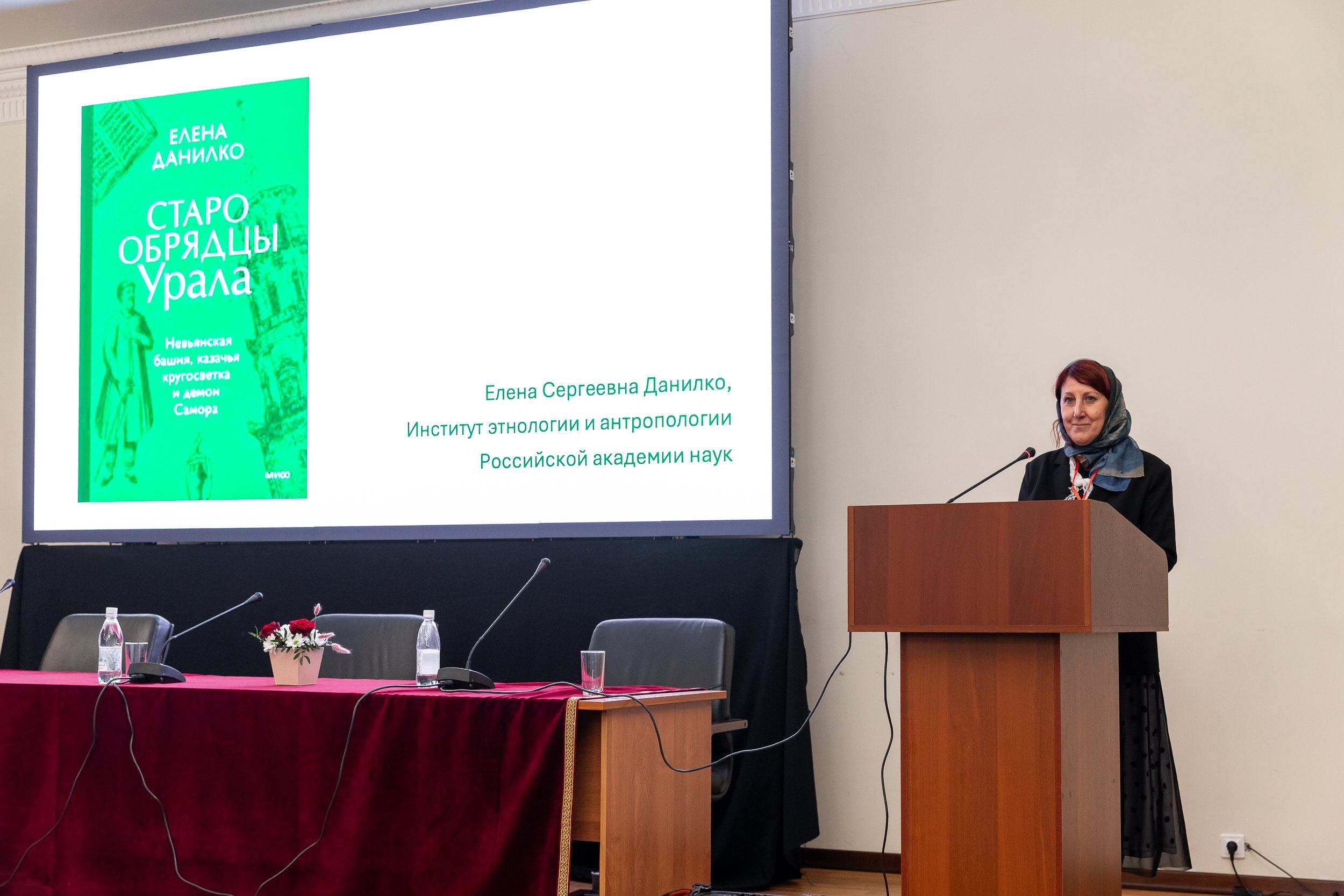
Next, Elena Danilko spoke about her new book, “Old Believers of the Urals.” Elena Sergeyevna is not only a writer but, first and foremost, a scholar: a Doctor of Historical Sciences, a nationally renowned anthropologist, and a senior research fellow at the Institute of Ethnology and Anthropology of the Russian Academy of Sciences. The Urals are the principal focus of E.S. Danilko’s research. The book grew out of scholarly expeditions, where archival documents come to life in oral accounts.
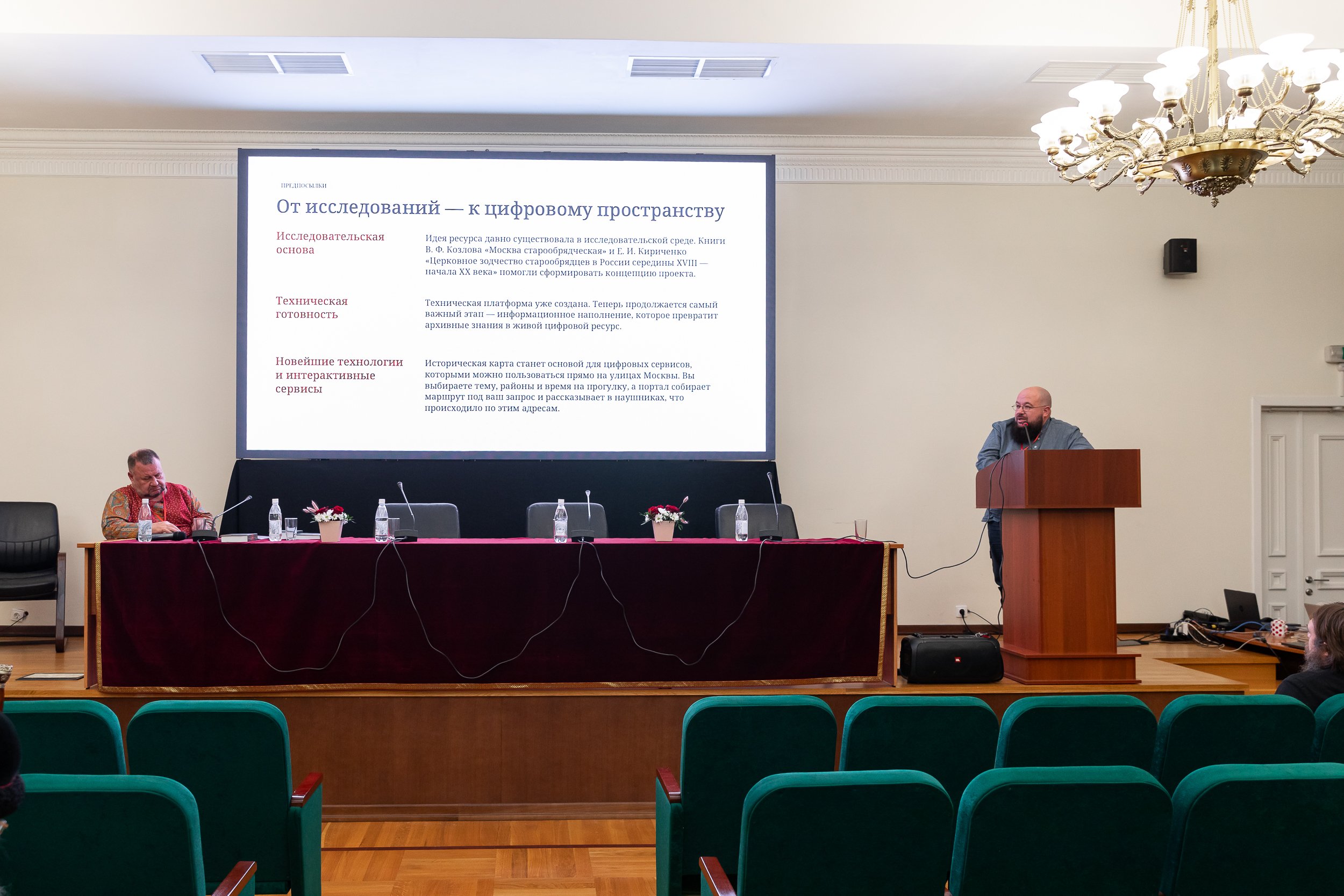
At the Melnikov Readings, the internet project, not yet open to the public, was presented by its principal creator, Andrey Andreyevich Makarantsev, Chairman of the Board of the regional public organization “Old Believer Capital,” which promotes the social and educational activities of Old Believers. The project, “Old Believer Capital,” aims to present Moscow’s Old Believer heritage in its entirety—both what remains and what has been lost—as part of the city’s history.
The idea of creating such an online resource had long been discussed among researchers. Its concept was shaped in part by two foundational books on the subject: “Old Believer Moscow” (by Vladimir Fotievich Kozlov) and “Old Believer Church Architecture in Russia from the Mid-Eighteenth to the Early Twentieth Century” (by Yevgeniya Ivanovna Kirichenko). The new portal’s interactive map will bring together all sites of Moscow’s Old Believer heritage in a single visual space. The capital’s map will show all Old Believer churches, chapels, and community houses, each with its own page featuring historical information and archival photographs.
As Andrey Makarantsev noted in his presentation, this project will probably never be definitively complete, since it will continue to be supplemented with new information about the inexhaustible history of Moscow’s Old Believers as scholars carry on their archival research.
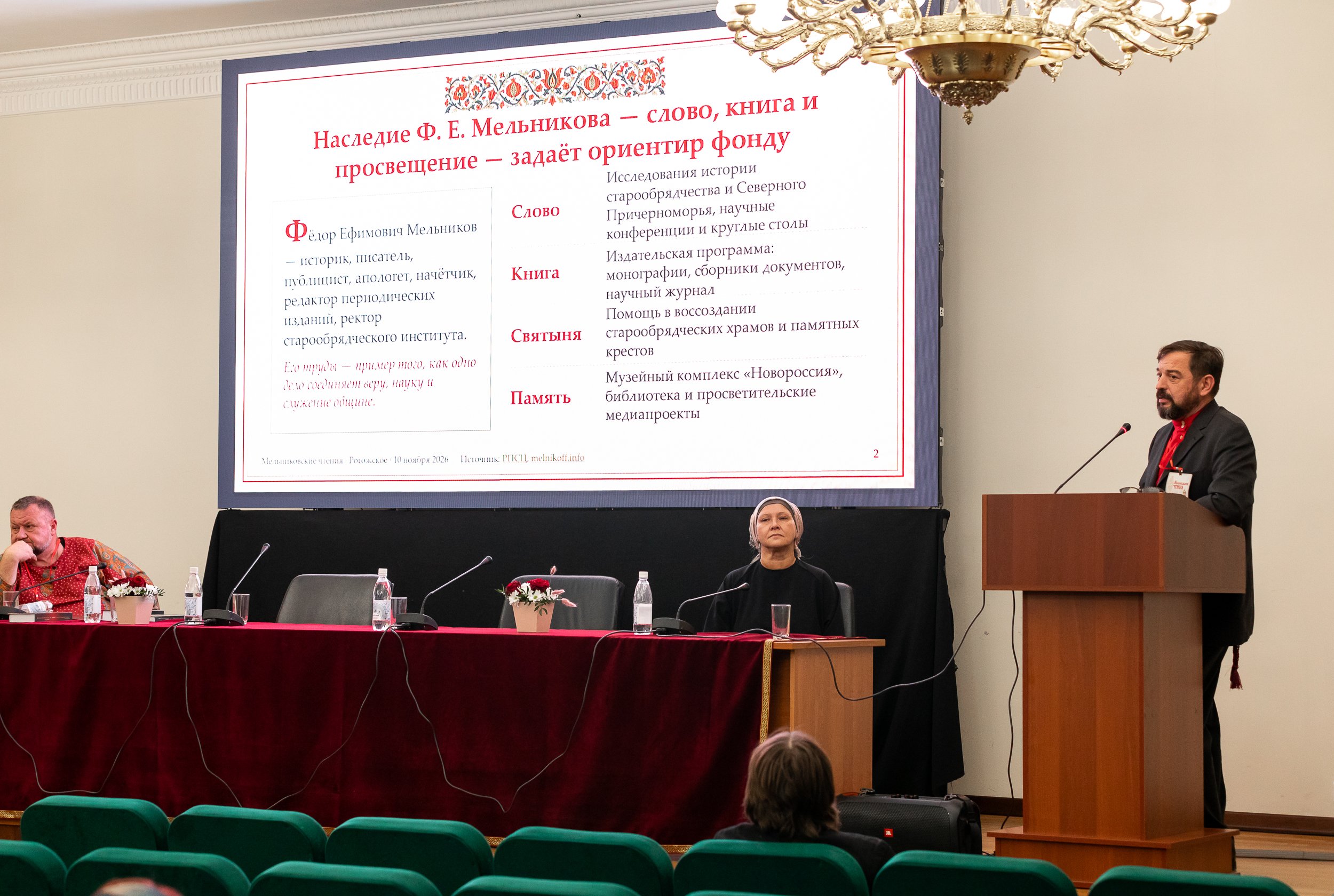
The first day of the Melnikov Readings concluded with a presentation entitled “The Cultural and Educational Mission of the Blagotvorenie Public Benefit Foundation,” delivered by Alexander Prigarin, president of the foundation, and its director, Nadezhda Volkova. Registered almost two years ago, the foundation is already well known among Old Believers. One of its most recent initiatives was organizing and holding the pan-Old Believer roundtable “The 350th Anniversary of the Suffering of the Solovetsky Martyrs.”
The foundation’s main programs focus on the following areas: science and culture; preservation of cultural heritage sites; the historical and cultural heritage of the Northern Black Sea and Azov regions; and rehabilitation and social support. Thanks to Professor A. A. Prigarin’s wide-ranging scientific and professional connections—and, above all, his personal relationships—a circle of like-minded people has formed around the Blagotvorenie Foundation, and they actively participate in its various initiatives.
An important part of the Blagotvorenie Foundation’s work is its publishing program. Recent examples include the publication by the Archaeodoxia press, headed by Alexey Bezgodov, chairman of the Russian Council of the Ancient Orthodox Pomor Church, of a new book by Alexandra Boytsova and Alexander Prigarin, “Old Believers of Astrakhan Region, 1945–1955.”


The eventful first day of the Melnikov Readings came to a close. Metropolitan Korniliy delivered the closing remarks, emphasizing the importance of this new forum, praising the significance of the papers and presentations, and supporting the wish expressed by most of the participants that the forum become an annual event.
Translated from the original article in Russian.
