

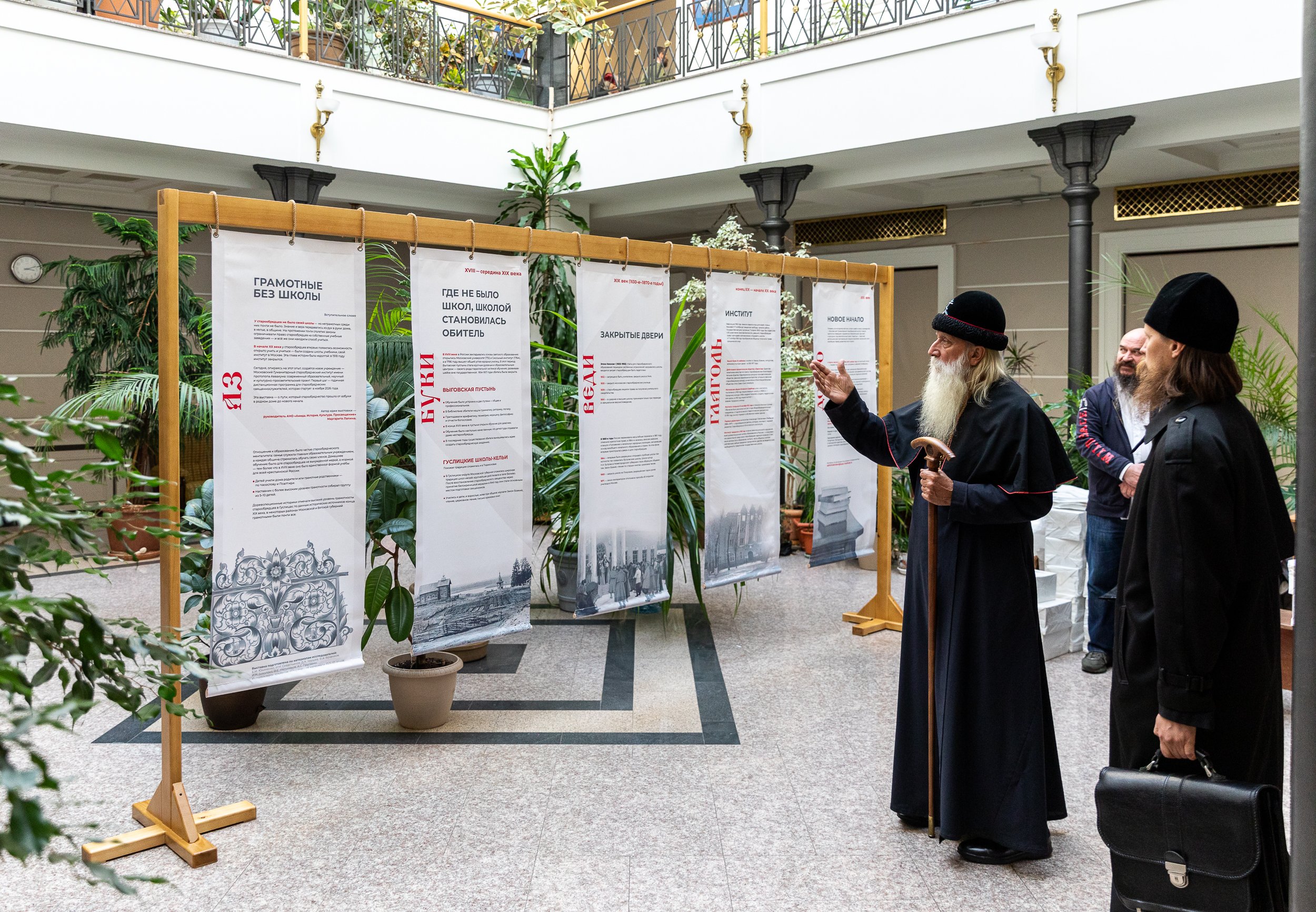
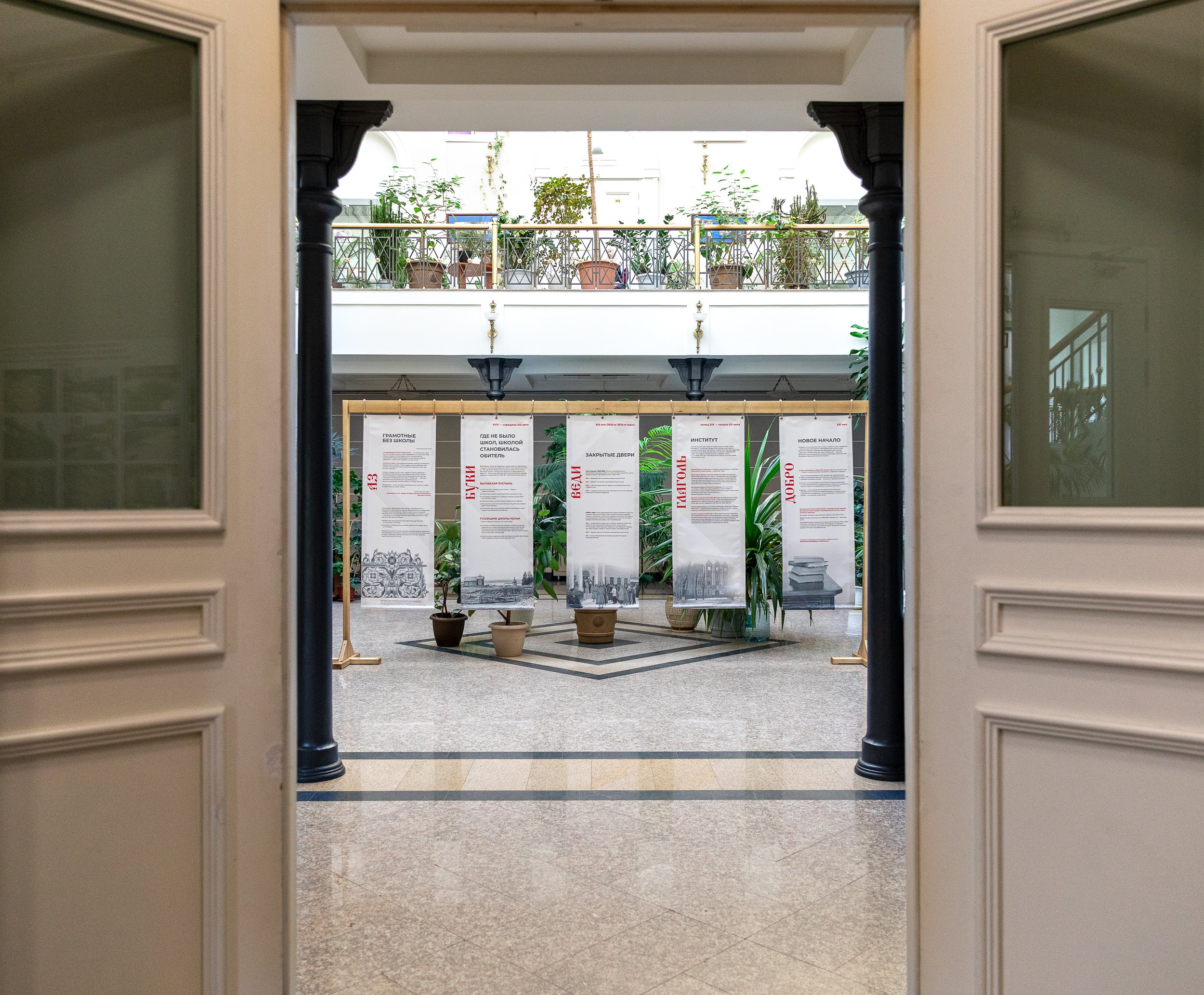
The question of reviving the Orthodox Humanities Institute named after Archpriest Avvakum, which has been raised at meetings of the Consecrated Council and the Metropolitanate Council of the Russian Orthodox Old Believer Church in recent years, has sparked broader interest in Old Believer education. The information display “Literate Without a School,” presented during this year’s Consecrated Council, told the story of how Old Believers studied over the centuries, the challenges they faced, and why this experience deserves renewed attention today.

The exhibition was conceived by Margarita Lapina, director of the Amida: History, Culture, and Education nonprofit organization. The exhibition is divided into five sections, named for the opening letters of the Church Slavonic alphabet: Az, Buki, Vedi, Glagol, and Dobro. Each is devoted to a different historical period.
Az. Home Schooling
Old Believers did not always have the opportunity to open their own schools, but very few among them were illiterate. The family served as the principal “educational institution.” Children were taught by their parents or literate relatives using the Psalter and Horologion (Book of Hours). A person with greater literacy might live with a family to teach the children, sometimes gathering a group of five to ten children. In the eighteenth century, home schooling was practically the only option available to Old Believers.
Historians before the Revolution noted the high level of literacy among Old Believers in Guslitsy. According to sources from the late nineteenth century, nearly everyone was literate in some districts of Moscow and Vyatka Governorates, where many Old Believers lived.
Buki. Eighteenth to mid-nineteenth century: where there were no schools, monasteries became schools
In the eighteenth century, the foundations of secular education were being laid in Russia: Moscow University opened in 1755, followed by the Smolny Institute in 1764, and in 1786 a general charter for public schools was issued. At the same time, Vyg Hermitage became a major spiritual and educational center, a kind of parallel system of learning outside state control. Education there was divided into two levels, general and vocational: reading, znamenny chant, copying books, the art of miniature painting and ornamentation, icon painting, and woodcarving. Arithmetic, geometry, medicine, philosophy, and theology were also taught. A school for girls opened in the late eighteenth century. The quality of education was such that even families who were not Old Believers sent their children to the hermitage. In the final years of the monastery’s existence, plans were being developed for an Old Believer academy. In 1854–1857, the monastery was closed and plundered by the authorities.
A similar educational tradition developed in the Moscow region. Children and adults studied while living in a community: they learned the Law of God, reading, church singing, and writing books in kryuki notation. School cells operated in Guslitsy, the largest in the village of Belivo. After the three-tier hierarchy was restored in the Old Believer Church in 1846, Guslitsy became one of the principal places for training priests.
Vedi. Nineteenth century: closed doors
The reign of Nicholas I (1825–1855) marked a period of systematic restrictions on Old Believer education. Schools were closed, and Old Believers were barred from teaching:
- 1832 — teaching was prohibited, and the school in Riga was closed;
- 1835 — the Moscow Old Believer school was closed;
- 1839 — Old Believers lost the right to obtain teaching certificates;
- 1850 — admission to secondary and higher schools was allowed only upon conversion to the officially recognized faith.
In the 1860s, Russia underwent sweeping changes: serfdom was abolished in 1861, the zemstvo reform began in 1864, and the Regulations on Primary Public Schools were issued. Against this backdrop, Old Believers were allowed for the first time in 1864 to open experimental literacy schools; the Bugrov schools emerged as a result. The school founded by Nizhny Novgorod merchant N. A. Bugrov became a model: it offered a dormitory, the Law of God, reading from old books, and kryuki singing. Yet in 1869 the school on Pokrovka, which had been authorized the previous year, was closed, and in 1871 the emperor personally rejected a request to open a school in Moscow.
Glagol. Late nineteenth to early twentieth century: an institute
The Revolution of 1905 changed the rules throughout the country. The Manifesto of October 17 granted civil liberties, and the State Duma began its work. The decree of April 17, 1905, “On Strengthening the Principles of Religious Tolerance,” gave Old Believers the right to teach their faith and open schools. Beginning on October 17, 1906, communities acquired legal-entity status and the right to open schools officially.
Between 1905 and 1917, more than twenty Old Believer textbooks and teaching aids were published on the Law of God, liturgics, the catechism, and Church history. Educational societies and brotherhoods were active, including the Brotherhood of Nachetchiks of the Precious Cross. The Moscow community at Rogozhskoye Cemetery moved gradually toward establishing an institute: it opened a primary school in 1905, a city school in 1906, and an institute in 1912. The institute opened on September 10, 1912, in Nikoloyamsky Lane, with a six-year program: four years of general subjects and two years of theology and pedagogy. In 1915, the institute moved into its own new building. Its first director was Aleksandr Stepanovich Rybakov (1884–1977), a historian and linguist. In 1918, the institute closed amid the collapse of the entire pre-Revolutionary education system and internal disagreements among Old Believers about what education should be.
Dobro. Twenty-first century: a new beginning
Drawing on this historical experience, an Old Believer Orthodox Humanities Institute named after Archpriest Avvakum is now being established in Moscow. It is a modern educational, scholarly, and cultural-enlightenment project. The first step is a yearlong distance-learning program for clergy; the pilot cohort for the 2026–2027 academic year will test the format, curriculum, and digital platform. The next steps will include obtaining a license, launching continuing education programs, and gradually developing a theological school, a general school, and a preschool program. Following the restoration of the historic building, a permanent campus will be developed, with facilities for classes and student residence, a library, and more.
To Be Continued
Old Believer education did not depend on official permissions and did not cease when it was banned. When there were no schools, when the law closed educational institutions or denied access to them, people taught at home, in a cell, or in a monastery. After religious freedom was granted in 1905, their own institute was established in 1912. The tradition of Old Believer education seemed to have been interrupted, but it did not disappear. Thus, the path from learning the alphabet at home to establishing their own higher Orthodox education can be understood as a continuation of tradition. In this sense, the Orthodox Humanities Institute named after Archpriest Avvakum does not begin from scratch. It continues a work that Old Believers carried out for centuries and that is worth consciously and collectively reviving.
Translated from the original article in Russian.
